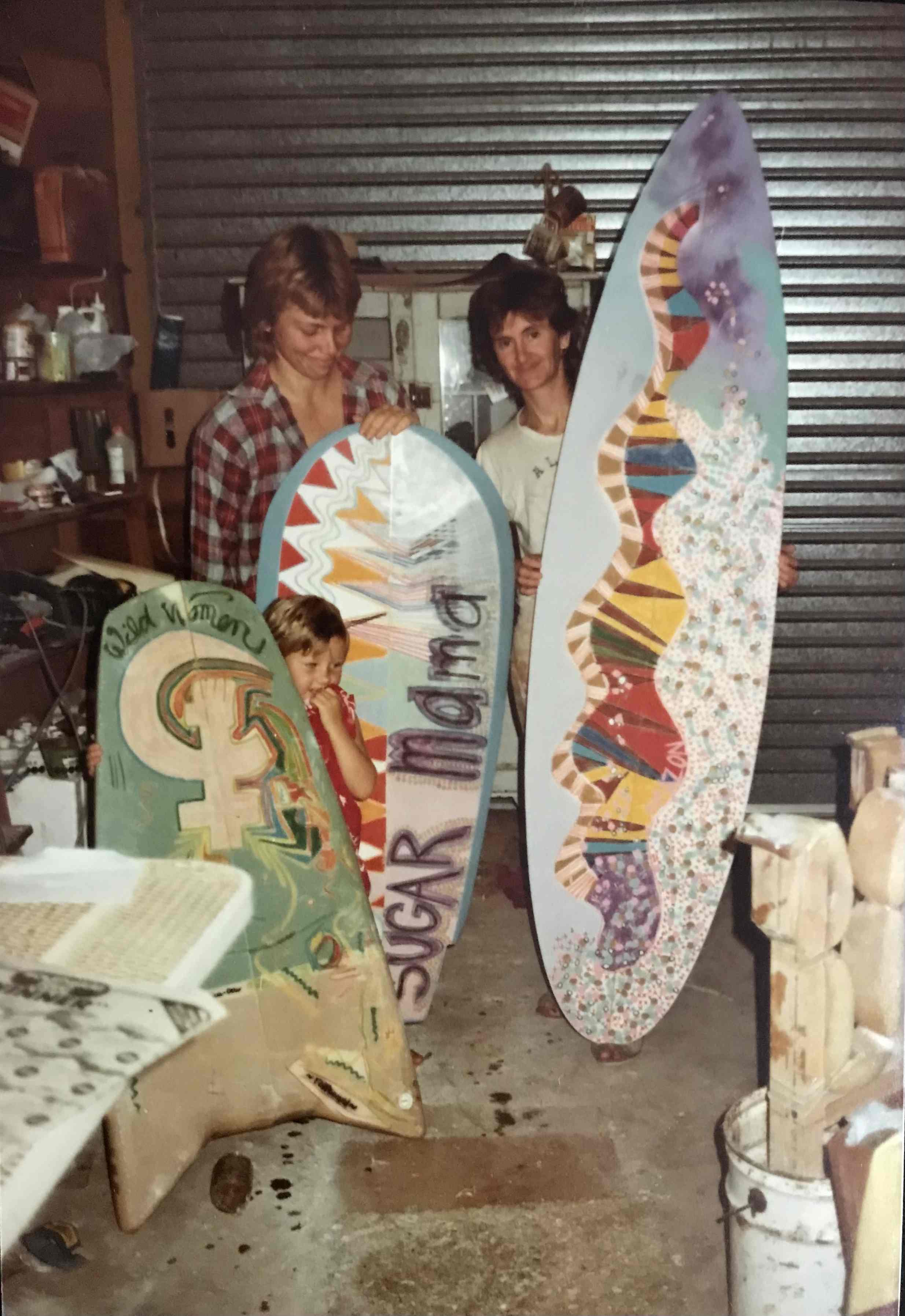
Wild Women Surfboards.
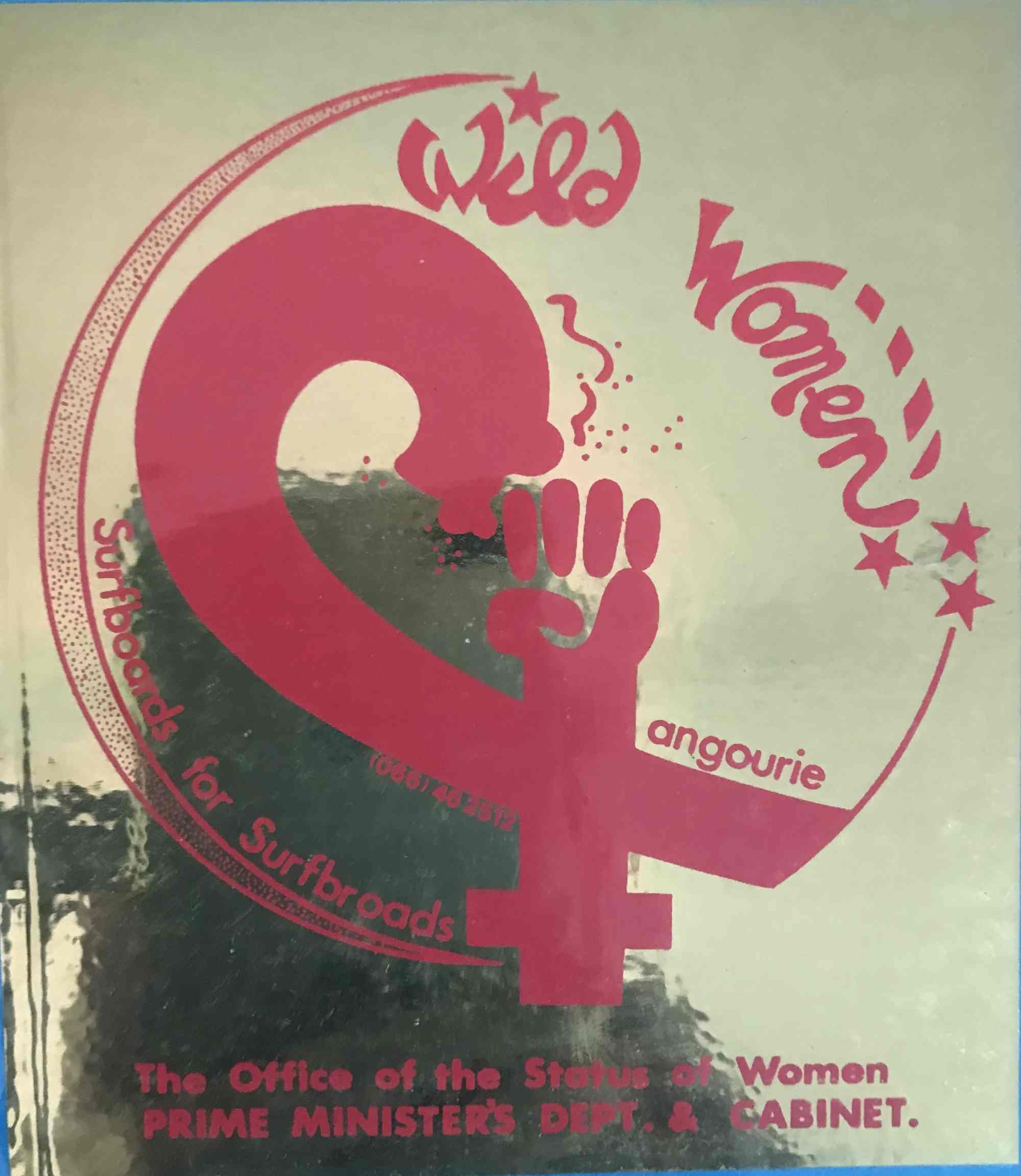
Photo courtesy of Cougar Wicce-Otter
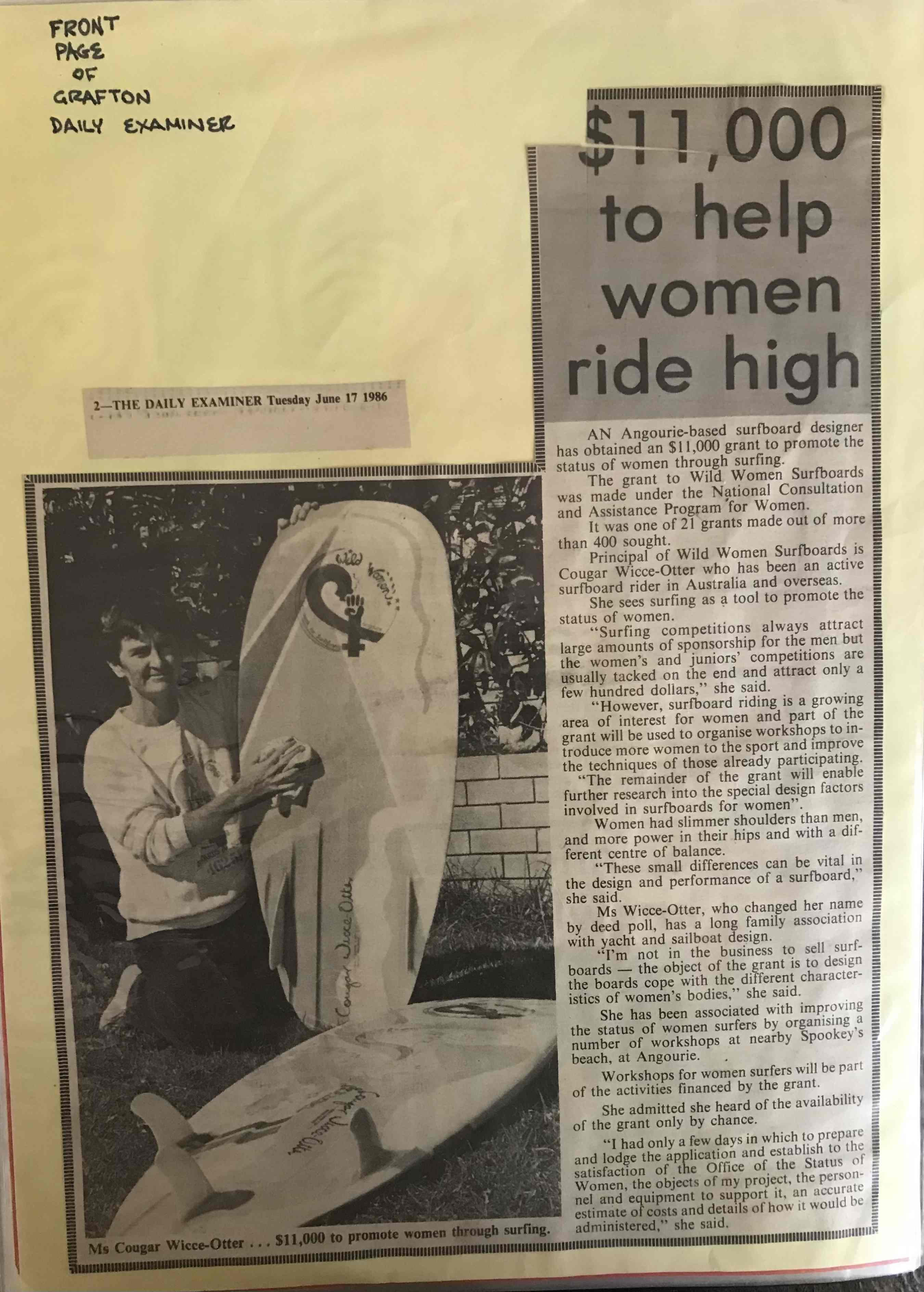
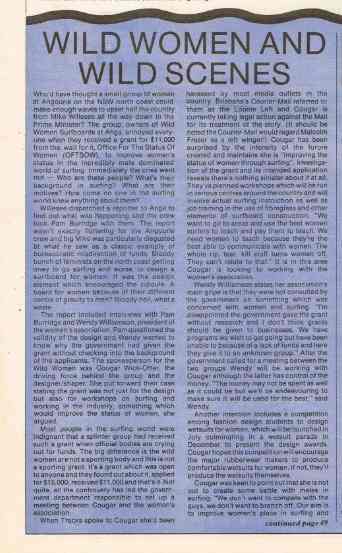
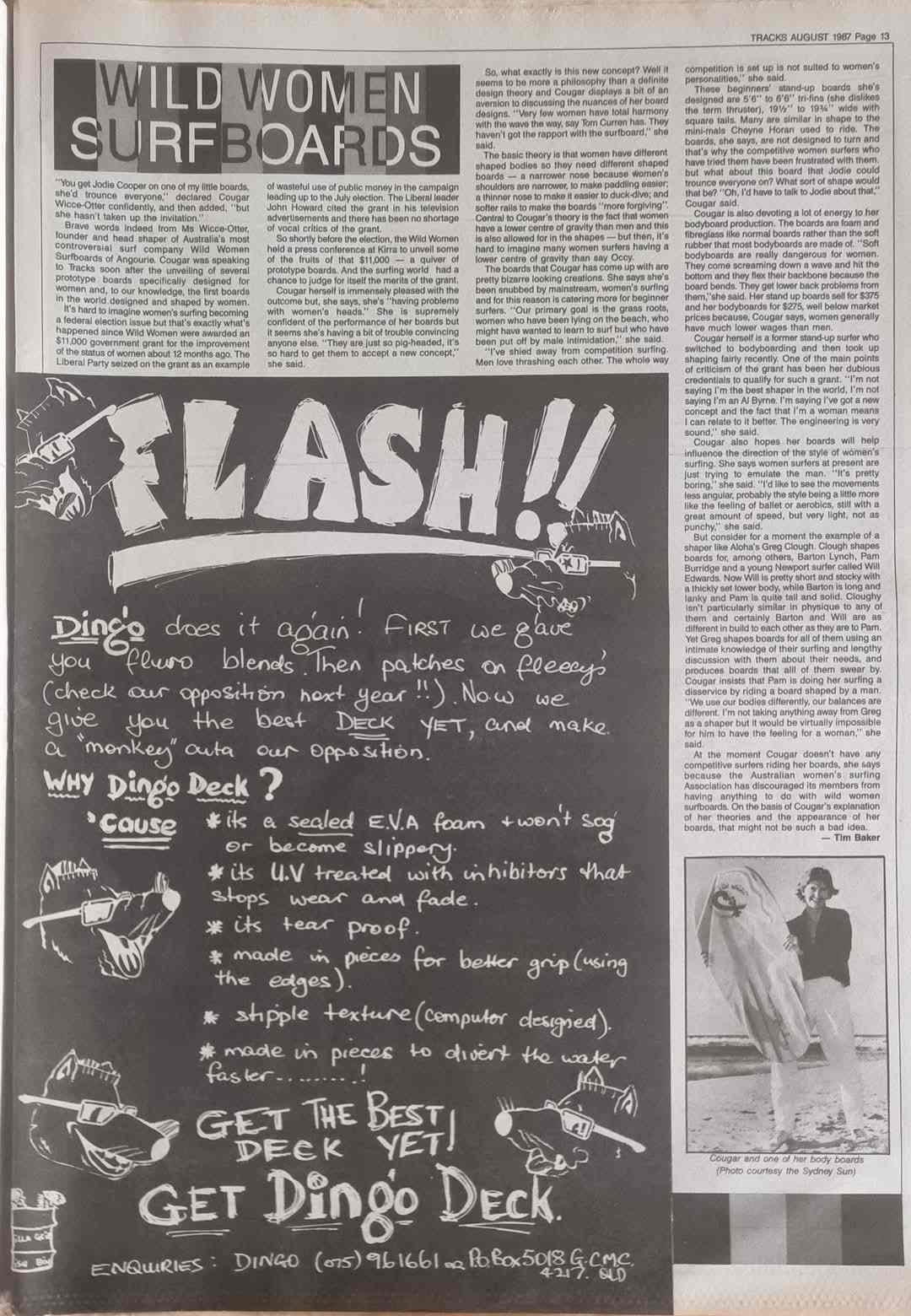
Obtaining a Government Grant to develop surfboards specifically for women, Cougar was abruptly thrust into the media spotlight. This wasn't just ideology, Cougar had studied yacht design, had watched her father build boats and had a familiarity with tools. From this background and a "if you want something that’s not available, you make it" attitude, Wild Women Surfboards was born.
|
Wild Women Surfboards. |
|
|
|
Photo courtesy of Cougar Wicce-Otter |
1. When and where did you begin surfing? What was your first board?
During family caravan weekends and school holidays at Easts Beach (Kiama) from age about 7-8yrs. There was just a family collection of rubber surf floats, styrofoam floats and mini surfboards, plywood skid boards, plywood paddle surf ski, canoes, hand surfing planes, balsa stand ups that transitioned into fibreglassed foam core stand ups. As a family of four (plus cousins and their collection of crafts) we just grabbed whatever, whenever. I did not really 'own' any boards, I never bought one from a shop, until I started making them and even then I never thought of them as 'my boards' but always as design prototypes in progress.
2. Unlike many others, you transitioned from stand-up surfing to bellyboards. When was this and why the change?
The transition was more like from yacht design to bellyboards. I returned to Australia in 1982, after I had studied Yacht Design when I was living in Maine, USA and I moved into my house I had at Angourie. My daughter was born in the USA in 1981 and my partner & I decided Oz was a better place to raise a kid. We didn't have much money then so when it came to playing with our then 2 daughters, I decided I would use the lessons I learnt from Yacht Design and make some stand ups, and of course for little kids they were more like boogie boards. The commercial rubbery boogies were so wide at the nose the kids could not paddle and also would chafe my upper arms. So something had to be done!
3. An interesting part of Angourie surfing history was the number of women surfing bellyboards. Did this influence you?
The increase in the numbers of women surfing at Angourie Note 1 happened during/after I had executed the programme for the Grant I received from The Prime Minister's Department around 1986. Before then there were not so many, but the few were dedicated, and in that respect their presence probably did cause me pause to think other women could/should do this and thus give me confidence to apply for the Grant.
|
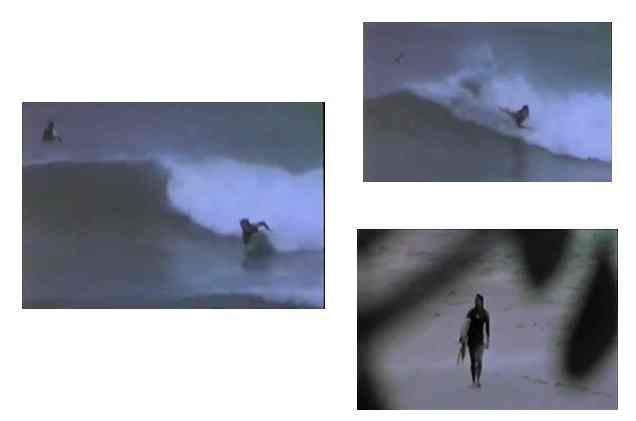
Greg Webber and Diana Lobry, 1984. |
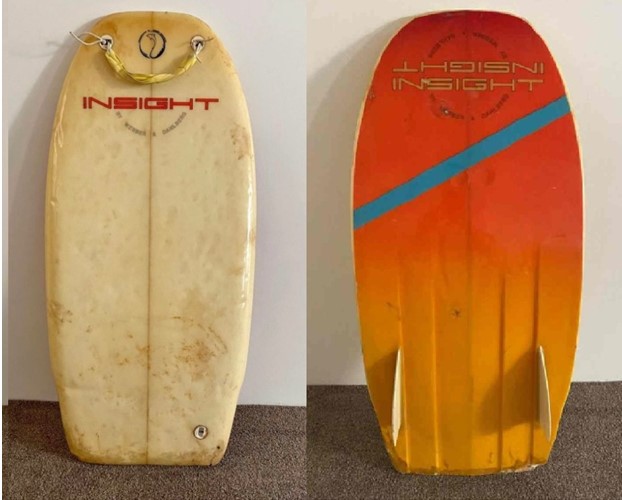
c.1986, Insight bellyboard. |
|
|
|
Dan Webber Surfing Angourie Point 1984; Lyttlestreet/Instagram and Mark Plummer. |
|
4. I read you began making boards around 1984. There were very few women in the surfboard industry at this time, what motivated you and how did you learn about shaping and glassing?
The boogie boards available in the shops at the time did not work for me or the kids. Too buoyant to duck dive easily for small folks, too wide to paddle without chafing upper arms and to get good deep strokes for acceleration and turning, too bendy and therefore had potential for back injuries on dumpers, no fun or personalised art work, and so on. They were heaps of fun, but the designer in me just had to see what I could do to refine them.
5. When you obtained a government grant in 1986 there was local and national media attention, as well as mention in parliament. The grant was criticised on a number of grounds, from the need for such boards to it being a "loony left" idea. How did this reception at the time impact on you and looking back at it now, what do you think about the reaction?
The impact it made upon me and my family was profoundly hurtful. Naively, I was shocked that these critics could not see the 'bleeding' obvious; that women's bodies are very different to mens and in physical sports even small adjustments to equipment can make a huge difference to performance and comfort. Perhaps having grown up in the well-heeled Sydney North Shore I was protected from most abuse and misogyny like that. It was a huge wake-up call. Looking back I can see it in perspective of how women were generally treated across most walks of life at that time, so I take it less personally nowadays.
|
"$11,000 to help women ride high". |
"Wild women and wild scenes". |
|
|
|
Author Unknown (1986) Grafton Daily Examiner, 17 June, Cover; Author Unknown (1986), Tracks Magazine, August, page 11. |
|
|
Wild Women Surfboards. |
|
|
Baker, T (1987). Tracks, August, page 13. Reformatted courtesy Warrwick Hoad. |
|
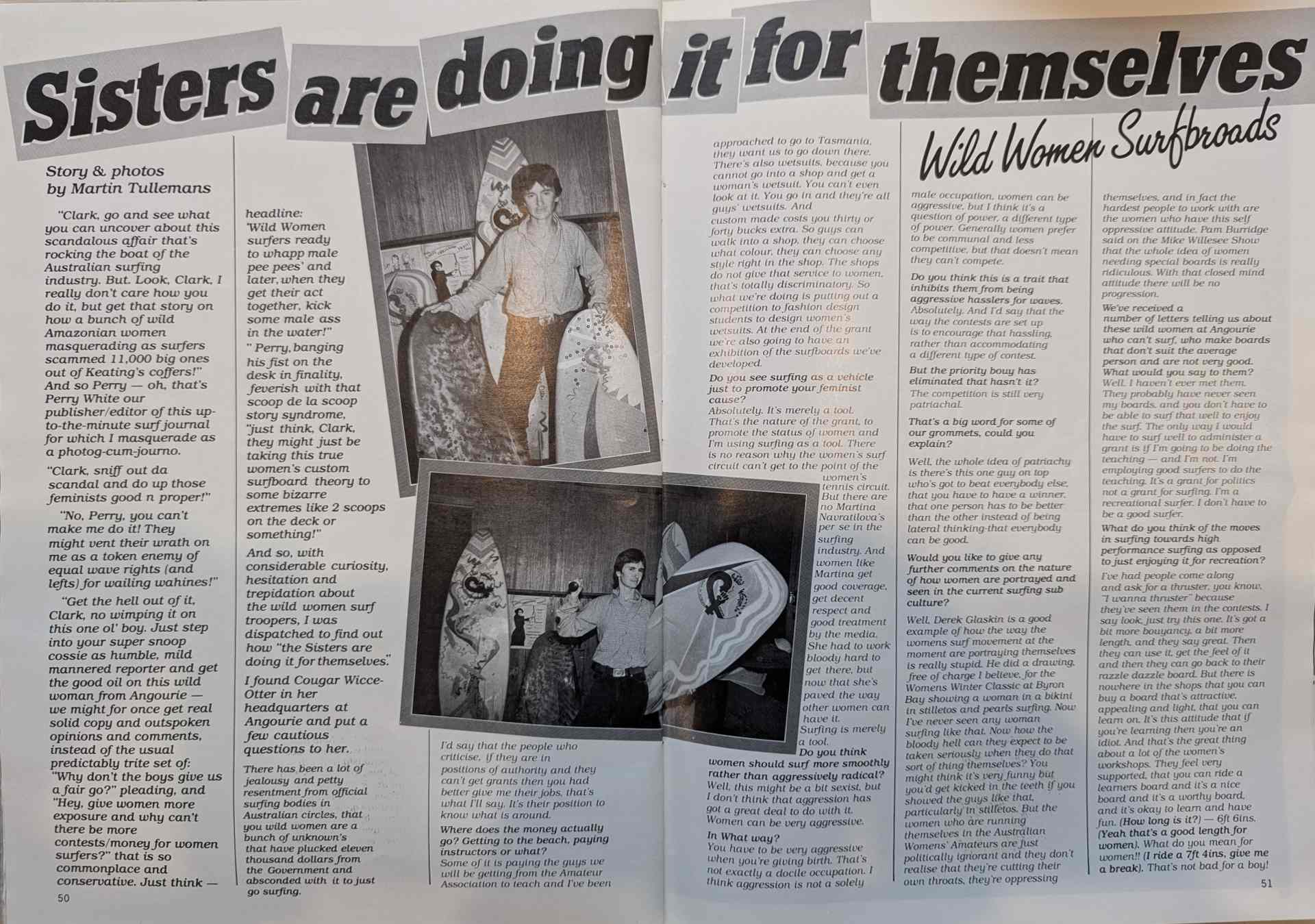
"Sisters are doing it for themselves" . |
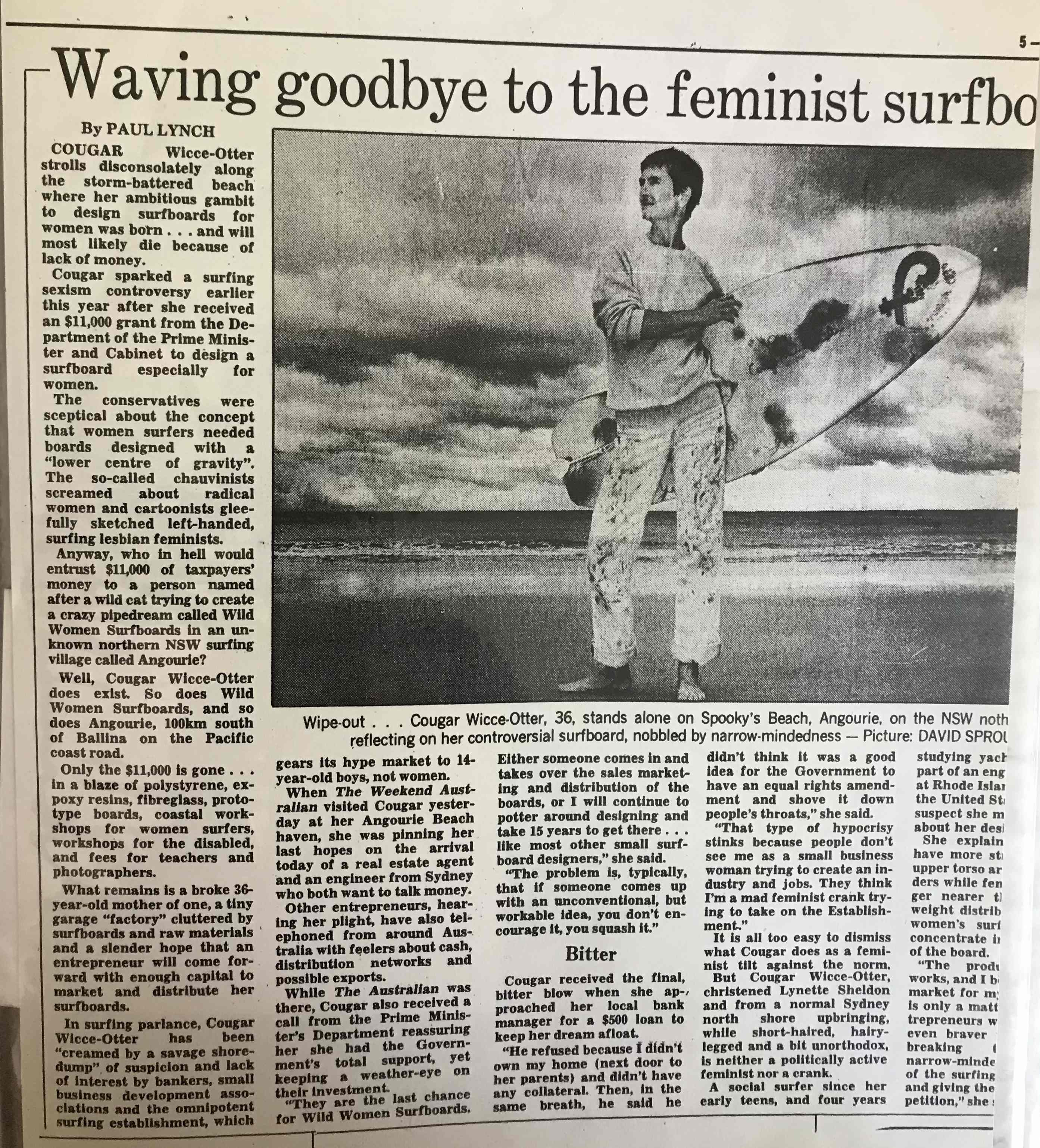
"Waving goodbye to the feminist surfboard". |
|
|
|
Tullemans, M (1986). Australias Surfing Life, November, pp. 50-51; Lynch, P (1986). Australian, page 5. |
|
6. How many boards did you make and did your board designs evolve over time? What influence did Rod Dahlberg and Greg Webber have on your boards?
I made dozens, but I don't recall the actual number and yes, the designs evolved every time. As a designer you are never content the moment you can spot an area you can refine. Rod and Greg, and John Webber as well, were supportive in showing me the tools they used and encouraged me to give it a go. Local Councillor Peter Cummings was fabulously supportive and rode some of my boards. That act alone by Peter was putting his neck out to other 'blokes', saying 'let her be'. I was not really influenced in design by Rod and Greg, because the whole nature of the programme was to research and explore the possibilities of new designing for women.
7. Besides seeing wider noses as unnecessary for women because of their build, what were the key design principles that you were incorporated into your bellyboards?
Drag affects lift, affects resistance. The nose design is critical, not just to accommodate the width of the shoulders for paddling efficiency but its upward curve and amount of wetted surface area determines the 'angle of attack' and amount of resistance. The more streamlined the entry point into the wave, the less resistance, the greater potential for increased speed, increased manoeuvrability (dependant on how the remainder of the board is also shaped).
Surface finishing also affects friction drag. Golf balls, for example, have dimples to create turbulence that increases speed and straightness of flight (and yes I did try them for fun lol). Gloss versus matt finishes and the hardness of the resin also influences frictional drag. And concave plays a big part in manipulating water flow under the board. Prone riding spreads the weight of the downward force further over the board imposed by the rider, compared to knee or stand up. Men generally have more weight in their upper body and women more in their lower body, thus distribution of rider down-force is different between men and women. The angle of the rails was also an area I played around with.
8. You ran nine workshops which attracted interest from within Australia and overseas. What was the aim and content of the workshops?
To provide a space where women would not be dominated by mens questions and goals, to inform how design affects usability and to learn some basics of how to use a board.
|
Cougar and a workshop participant |
|
|
Photo courtesy Cougar Wicce-Otter |
9. I've read that you also branched out into making wetsuits, which in the mid 1980s was an idea a little ahead of its time. Did you make many wetsuits?
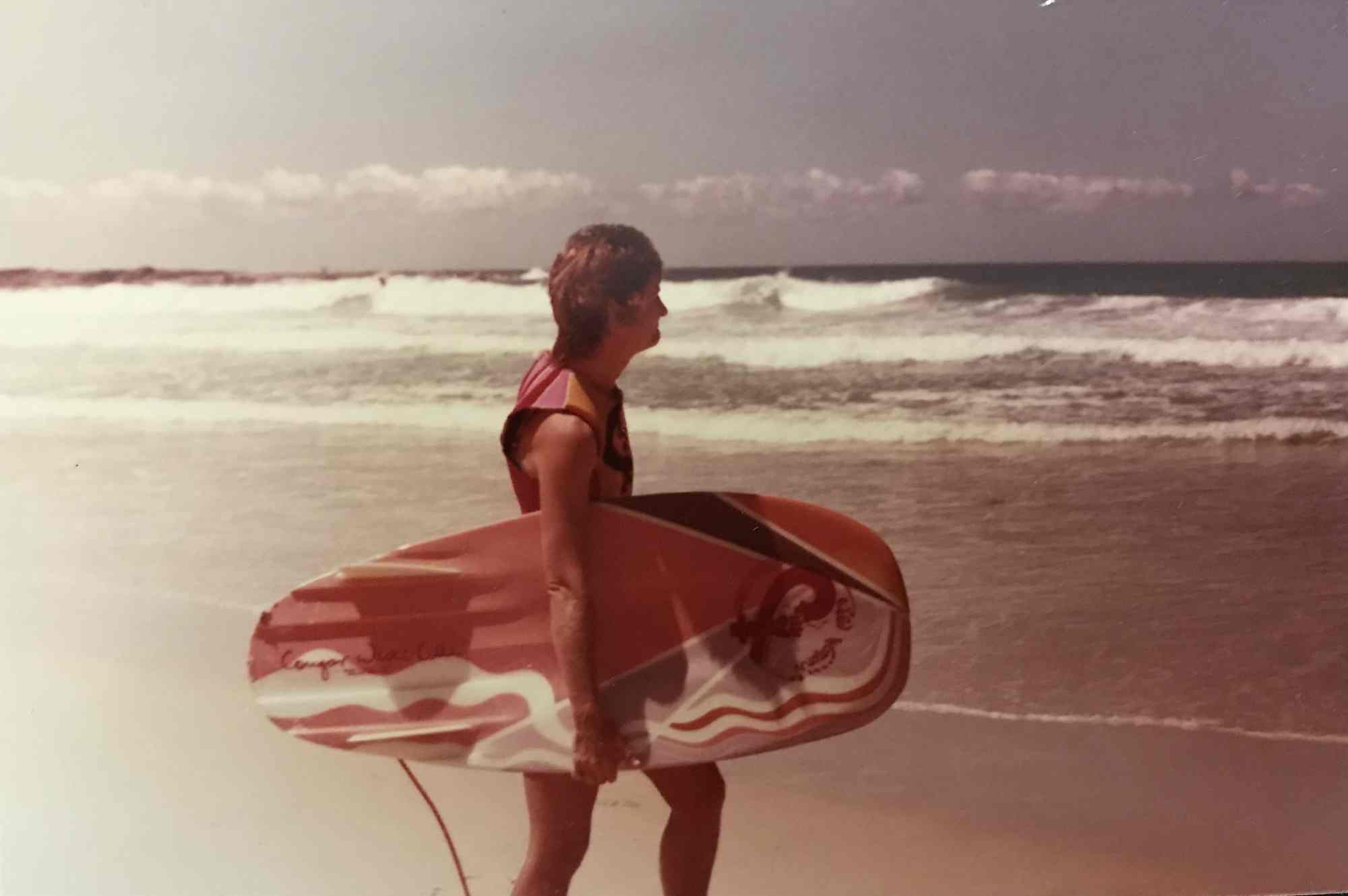
Women's wetsuits could be had if custom made but they were not available Prêt-à-porter / off the rack. As part of the Grant proposal I engaged a professional fashion designer to create the block patterns and we made about a dozen suits. During the Grant programme we also made swimmers as during the workshops we had so many comments about the ill-fitting, uncomfortable and inappropriate swimming cozzies that were only available.
|
Wild woman board and westuit, Spooky Beach 1986 |
|
|
Photo courtesy Cougar Wicce-Otter. |
10. Did you mostly surf Angourie? Any waves or surfs stand out over the years?
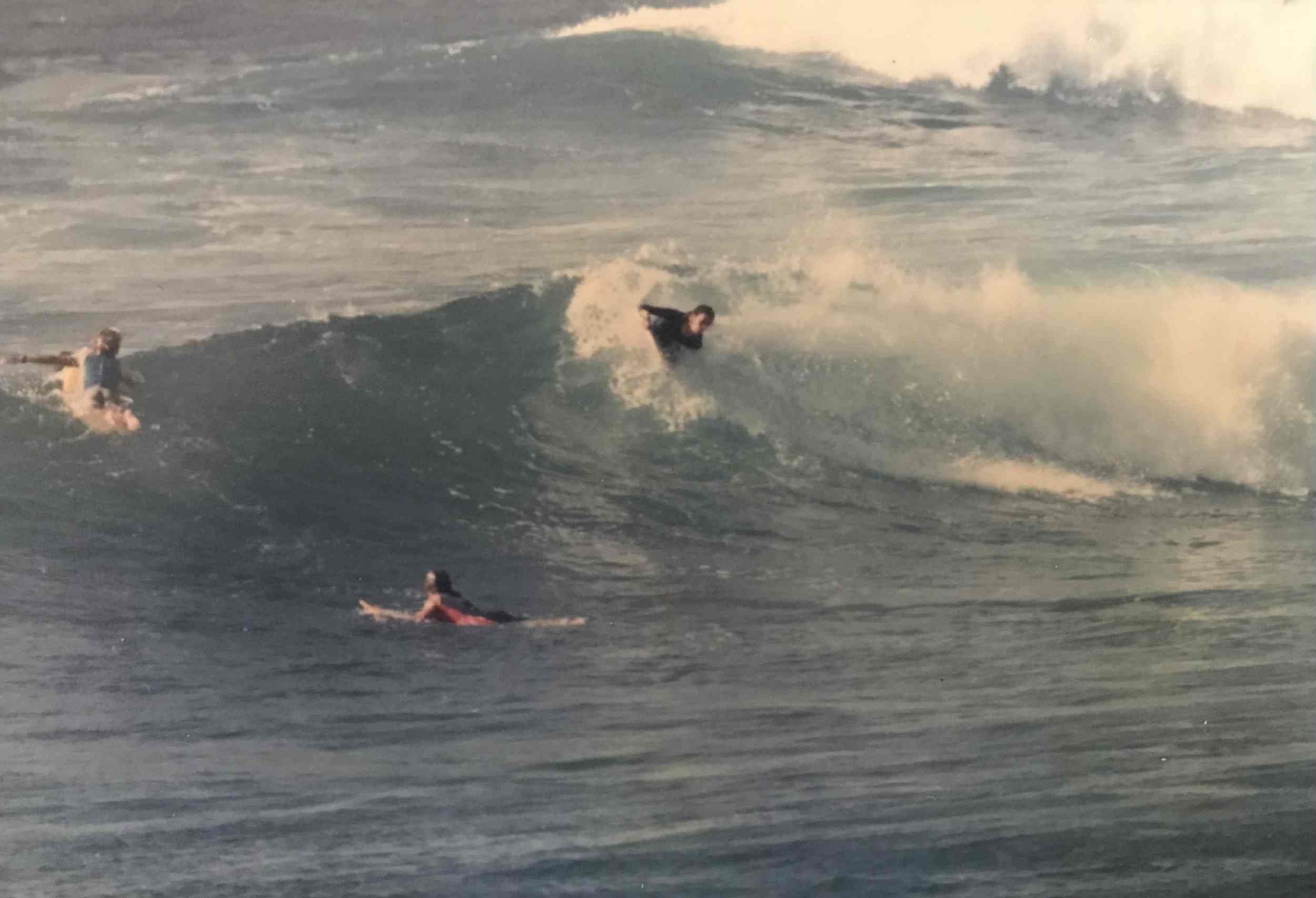
Mostly went to the Gold Coast as more kid suitable. As a mother any wave that didn't dump your precious little ones was a win!
|
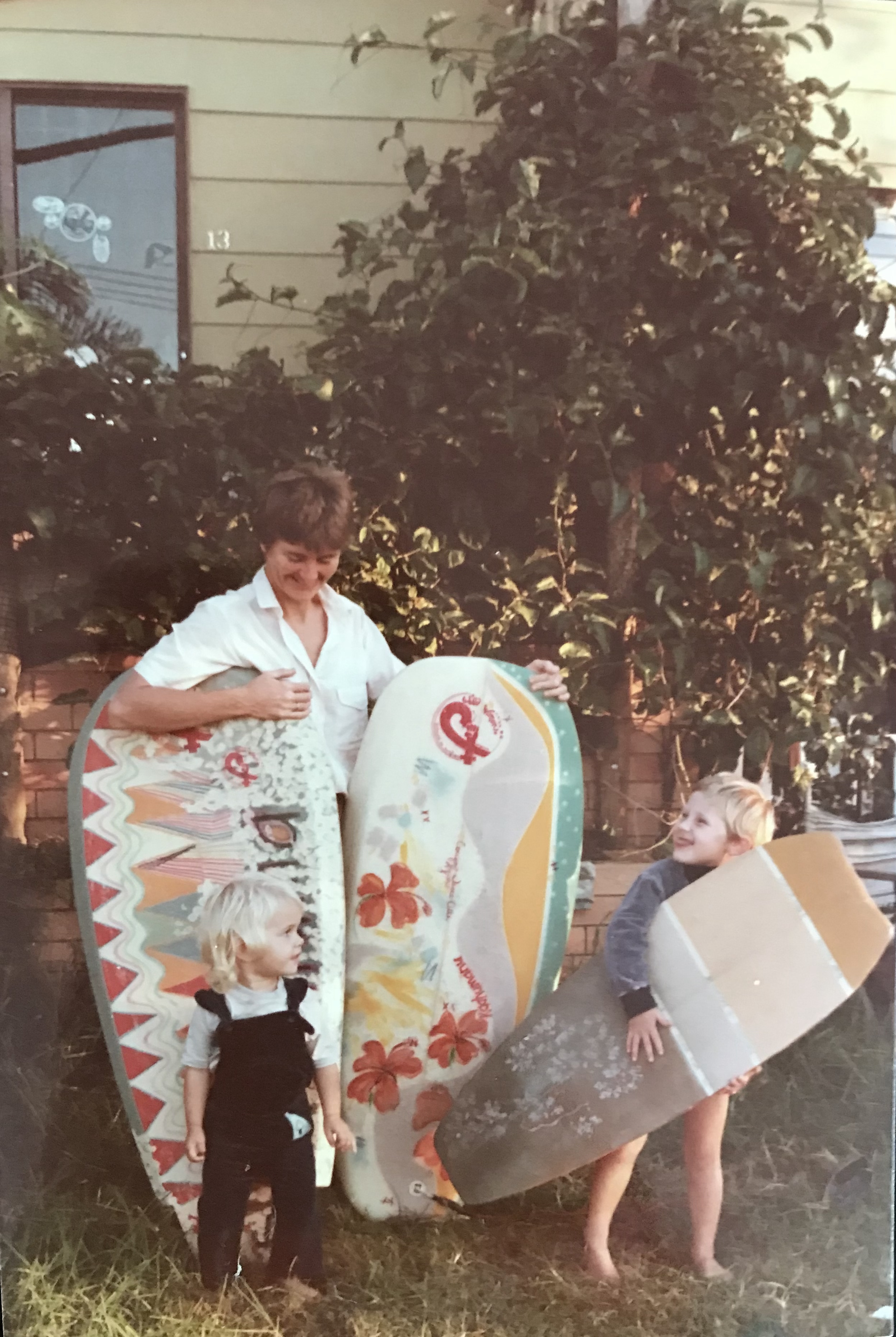
1986, children and boards. |
Definitely not the Gold Coast, putting theory into practice. |
|
|
|
Photos courtesy Cougar Wicce-Otter. |
|
11. What did you enjoy about riding bellyboards?
Being so close to the face of the wave with your own face. Exhilarating.
12. Any final comments?
I completed a Bachelor of Animation(Griffith) in 2018 and during 1st year when the whole subject of how a body moves, centre of gravity etc. was taught, my jaw hit the floor when the same ignorance of the different ways men and women move was overlooked. The young, male lecturer trivialised me as badly as the 1986 media goons, when I said "ahhhh no, women don't move like that". Cartooning (as one of the categories of animation) is still often pretty sexist though. I completed my Masters of Animation, Games & Interactivity (RMIT) in 2025 and at Master's level it's a whole different group of brains you're dealing with. I graduated with Distinction, which kind of says that when support is given, one can excel even when challenging the status quo.
Notes